What does pro-Black actually require?
The difference between racial pride, political identity, and conduct that produces collective capacity.
Press · Interviews · Independent Review
Publication facts, editorial angles, downloadable assets, and review-copy information for journalists, scholars, librarians, booksellers, educators, podcasters, and institutional reviewers.
Internal red-team review is complete. Independent scholarly review and the reader pilot have not yet been completed. No outside publication, scholar, institution, or movement is represented as endorsing Version 1.0.
Inspect the public review record →The short version
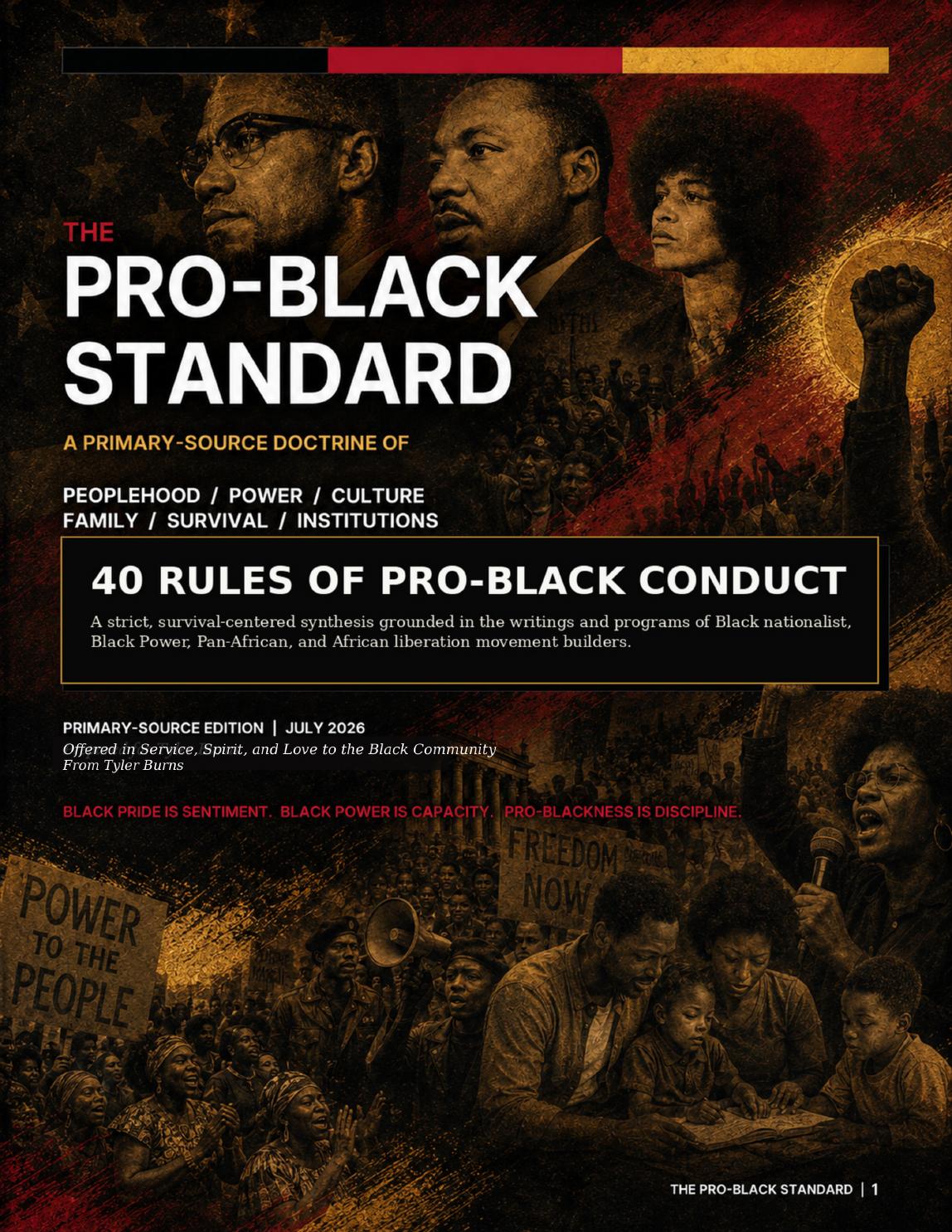
The Pro-Black Standard is a survival-centered doctrine that defines pro-Blackness through conduct and consequences. Its forty rules address peoplehood, political power, economic power, culture, family and continuity, and disciplined institution-building.
Every rule publishes an operational standard, explanation, practical example, failure test, doctrinal classification, and primary-source foundation. The larger project also publishes its method, source ledger, research briefs, review status, and amendment procedure so readers can inspect the reasoning rather than accept it on authority.
Black pride is sentiment. Black power is capacity. Pro-Blackness is discipline.
Interview and assignment desk
The difference between racial pride, political identity, and conduct that produces collective capacity.
The value and danger of translating Black nationalist, Black Power, Pan-African, and liberation traditions into explicit standards.
How a doctrine can expose contradictions between what people claim and what their institutions materially produce.
Why movements need administrative skill, succession, ownership, research, and interlocking institutions—not only mobilization.
How public sourcing, evidence classifications, criticism, and version memory can discipline a living doctrine.
Building an accessible research desk where readers can inspect definitions, calculations, limitations, and source files.
Editorial assets
For reviews, interviews, listings, and editorial coverage of the book.
Download cover →
Author, editor of record, and publisher of The Pro-Black Standard.
Download portrait →
A horizontal image for digital coverage and social sharing.
Download social card →These assets may be used for accurate editorial coverage, reviews, interviews, and event listings concerning Tyler Burns or The Pro-Black Standard. Use does not imply endorsement by the publication or the project.
Short biography
Tyler Burns is a Black writer, researcher, educator, and community advocate working across African American Studies, psychology, political education, and collective power. He is the author, editor of record, and publisher of The Pro-Black Standard.
Extended biography
Burns holds degrees in African American Studies and psychology, along with an African American Studies Skills Certificate. His community work includes youth education, direct outreach to Black people experiencing homelessness, and helping raise more than $40,000 for Black women refugees in Ethiopia and Sudan. He has appeared in public debate on Jubilee and writes through Afro Sparks on Black life, culture, relationships, political thought, and collective power.
Contact the project
Digital review copies are available to working journalists, editors, reviewers, scholars, librarians, booksellers, educators, podcasters, and institutional evaluators. Requests should name the outlet or institution, intended coverage, and deadline.